Water Recovery in Hydrometallurgy: Exploring the Potential of Temperature Swing Solvent Extraction (TSSE)
Hydrometallurgical processes generate highly saline and metal-rich wastewater that is difficult to treat with conventional methods like evaporation or reverse osmosis. Temperature Swing Solvent Extraction (TSSE) offers a membrane-free alternative that extracts water at low temperature and releases it at higher temperature, enabling efficient water recovery from challenging streams while using low-grade heat.
Hydrometallurgical processes are heavily reliant on water, which functions as both a reaction medium and a transport phase during the leaching, solvent extraction (SX), electrowinning (EW), and purification steps. Concurrently, these processes yield substantial quantities of aqueous streams characterised by elevated salinity levels, dissolved metals, acids, and organic compounds. The issue of water recovery has become a strategic challenge for modern hydrometallurgical plants, rather than a secondary utility issue, due to increasing pressure from sustainability targets, water scarcity, and stricter environmental regulations.
Conventional water recovery approaches, including evaporation, reverse osmosis (RO), and chemical treatment, frequently encounter challenges when confronted with streams characterised by high salinity and metal richness. Evaporation is an energy-intensive process, and membrane-based systems are susceptible to fouling, scaling, and limited tolerance to extreme ionic strength. These limitations have thus motivated the search for non-traditional separation technologies, among which Temperature Swing Solvent Extraction (TSSE) has emerged as a promising candidate.
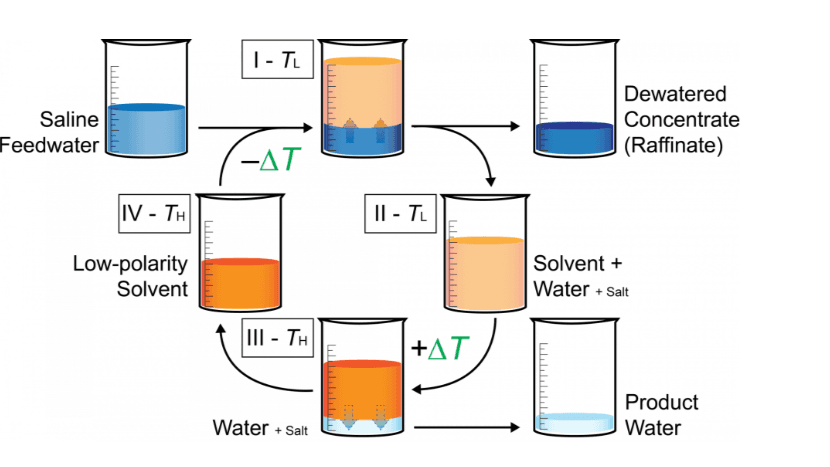
TSSE is a fundamentally distinct approach to desalination and water treatment when compared with conventional methods. Rather than employing membranes or phase change through evaporation, TSSE relies on the temperature-dependent solubility of water in a low-polarity organic solvent. In the context of lower temperatures, the solvent exhibits a selective extraction of water from a saline or metal-bearing aqueous solution, concomitant with a rejection of salts, metal ions, and the majority of inorganic species. A moderate temperature increase, typically below 70 °C, has been shown to result in the release of the extracted water from the solvent. This process enables the solvent to be recycled in a closed loop.
A salient feature of TSSE is its membrane-lessness and non-evaporative nature. This process eliminates fouling and high-pressure operation while circumventing the substantial latent heat penalty typically associated with evaporation. Research led by Columbia University's Yip Lab has demonstrated that TSSE can operate effectively even in hypersaline brines exceeding 200,000 ppm total dissolved solids, achieving high salt rejection and meaningful water recovery using only low-grade thermal energy.
From a hydrometallurgical perspective, this capability is particularly attractive. It has been determined that the effluents from solvent extraction circuits, battery recycling processes, water streams resulting from acid washing, and spent electrolytes frequently exceed the limits of practicality when it comes to reverse osmosis (RO) or nanofiltration. TSSE provides a means of decreasing wastewater volume, facilitating internal water recycling, and supporting near-zero liquid discharge (ZLD) strategies without the necessity of extreme operating conditions.
Another significant advantage is the potential for energy integration. A significant number of hydrometallurgical plants are responsible for the generation of low-quality waste heat, which is a by-product of leaching, neutralisation, or downstream thermal operations. TSSE has the capacity to directly utilise this heat, thereby converting an otherwise wasted energy stream into a valuable resource for water recovery. In this sense, TSSE aligns well with modern philosophies of process integration and energy efficiency.
It is important to note, however, that TSSE is not without its challenges. It is evident that there is still active research being conducted in the following areas: long-term solvent stability; solvent loss control; process kinetics; and scale-up design. The implementation of industrial deployment will necessitate the establishment of robust solvent management strategies, in conjunction with the integration of these strategies with existing process flowsheets. However, recent studies suggest that hybrid systems – for example, TSSE combined with membrane distillation or electrodialysis – could significantly enhance overall system performance and reliability.
In conclusion, Temperature Swing Solvent Extraction represents a paradigm shift in water recovery for hydrometallurgy. The decoupling of water separation from membranes and evaporation by TSSE engenders novel prospects for the treatment of saline, metal-rich streams that are otherwise considered problematic. As the industry evolves towards sustainable production of critical raw materials and battery metals, technologies such as TSSE are poised to assume an increasingly pivotal role in the future design of hydrometallurgical plants.
#Hydrometallurgy #WaterRecovery #ProcessEngineering #SustainableMetals #BatteryRecycling #CriticalRawMaterials #Desalination #TSSE #CircularEconomy #EnergyEfficiency
References
- Yip, N. Y. et al., Temperature Swing Solvent Extraction (TSSE): Membrane-less and Non-evaporative Desalination, Columbia University, Yip Lab https://yiplab-h2o-e-env.eee.columbia.edu/research-projects/temperature-swing-solvent-extraction-membrane-less-and-non-evaporative
- Yip, N. Y. et al., Hypersaline Desalination Using Temperature Swing Solvent Extraction, Columbia University https://yiplab-h2o-e-env.eee.columbia.edu/news/our-research-temperature-swing-solvent-extraction-hypersaline-desalination-accepted
- Temperature Swing Solvent Extraction for Salt and Glycerol Separation from Wastewater, Desalination Journal, 2024.
- Elimelech, M., Phillip, W. A., The Future of Seawater Desalination: Energy, Technology, and the Environment, Science, 2011.